Anatomy of a Spider
A journey through 400 million years of evolutionary design — from hydraulic limbs to silk-spinning organs.
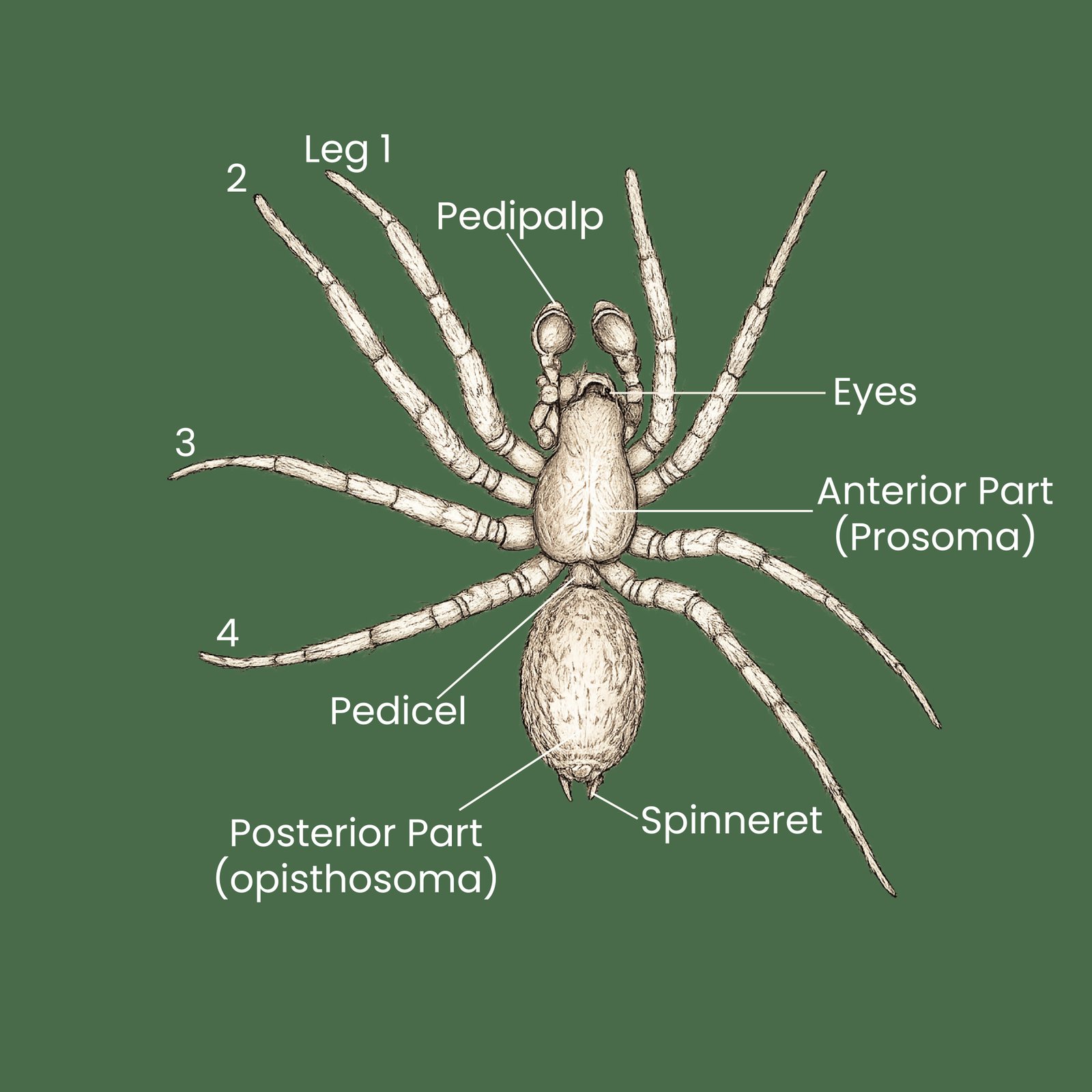
Full Body Overview (Dorsal View)
The spider's body is strictly divided into two primary tagmata (body regions) connected by a narrow, flexible stalk, facilitating both structural integrity and predatory mobility.
Anterior Part (Prosoma / Cephalothorax)
The fused head and thorax region. It serves as the neurosensory and locomotive hub of the spider, housing the brain, stomach, and major muscle attachments. All eight legs and the pedipalps articulate from this region.
Posterior Part (Opisthosoma / Abdomen)
The large, unsegmented posterior region. It contains vital visceral organs including the heart, respiratory organs (book lungs), digestive tract, reproductive organs, and silk glands.
Pedicel
A narrow, muscular cylinder connecting the prosoma to the opisthosoma. It allows the abdomen to move independently, which is crucial for directing silk delivery or maneuvering during egg production and defense.
Eyes
Positioned at the anterior front of the prosoma to provide an expansive field of view.
Pedipalps
A pair of jointed appendages located near the mouthparts, functioning as sensory organs and, in males, as intromittent mating organs.
Legs (1, 2, 3, 4)
Four pairs of ambulatory appendages numbered sequentially from anterior to posterior.
Spinnerets
Small, mobile finger-like appendages located at the posterior tip of the opisthosoma, containing microscopic spigots through which silk is extruded.
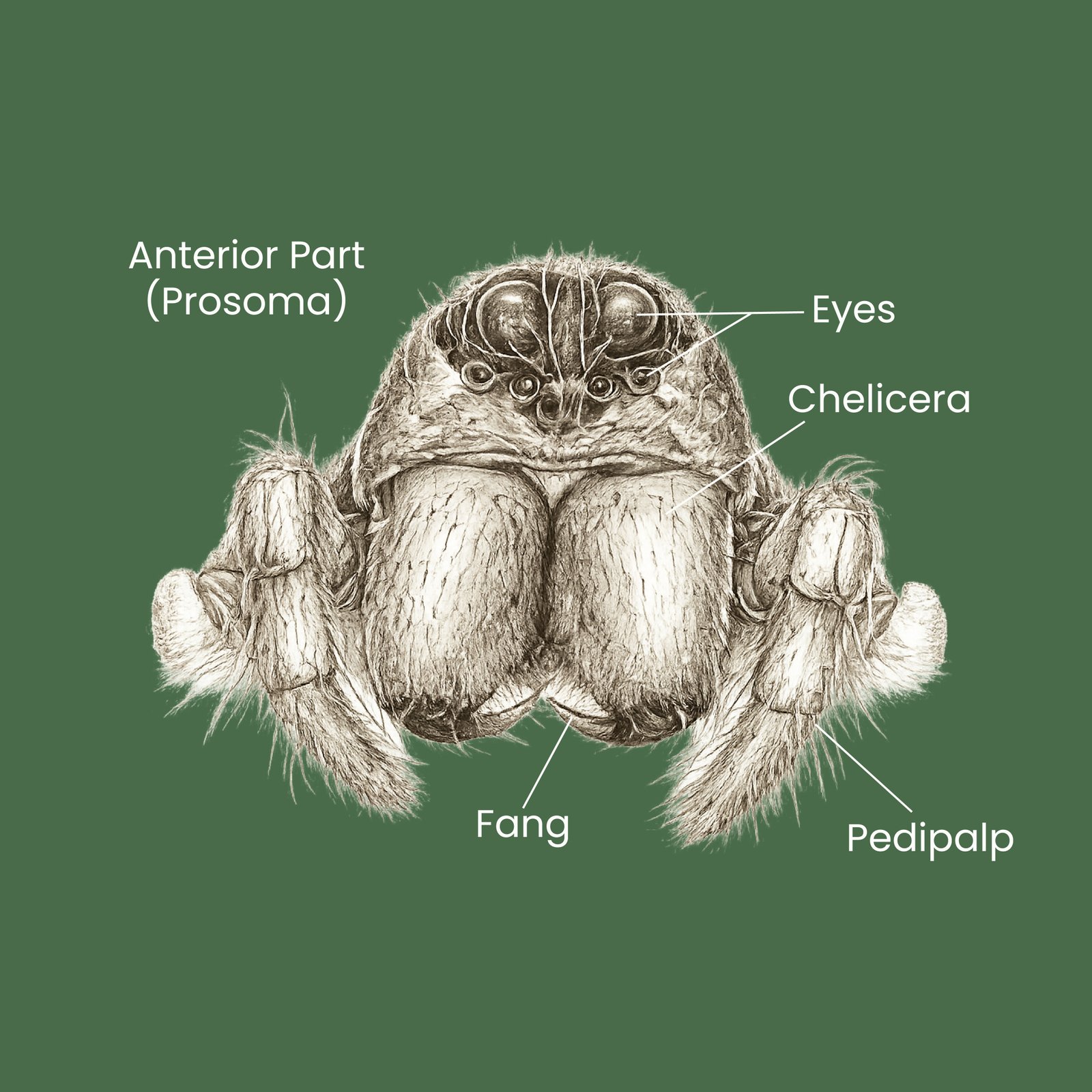
Head & Mouthparts (Anterior View)
The cephalic region is highly specialized for sensory perception, prey capture, and the initial mechanical breakdown of food.
Eyes (Lycosid Arrangement)
Wolf spiders possess eight eyes arranged in three distinct rows — a top row of two medium-sized eyes, a prominent middle row consisting of two exceptionally large Anterior Median Eyes (AME) that provide high-resolution telephoto-like vision, and a bottom row of four smaller eyes providing a wide-angle view of the horizon.
Chelicerae
Massive, muscular structures situated below the eyes. They act as the jaws of the spider, providing the mechanical power needed to hold struggling prey.
Fangs
Sharp, curved, hollow structures at the distal end of each chelicera. The fangs fold into a groove when at rest and swing out to pierce prey, injecting venom from internal venom glands to immobilize and pre-digest the target.
Pedipalps
Flanking the chelicerae, these short, leg-like appendages are heavily covered in chemosensory hairs (setae) to taste and feel objects in the environment.
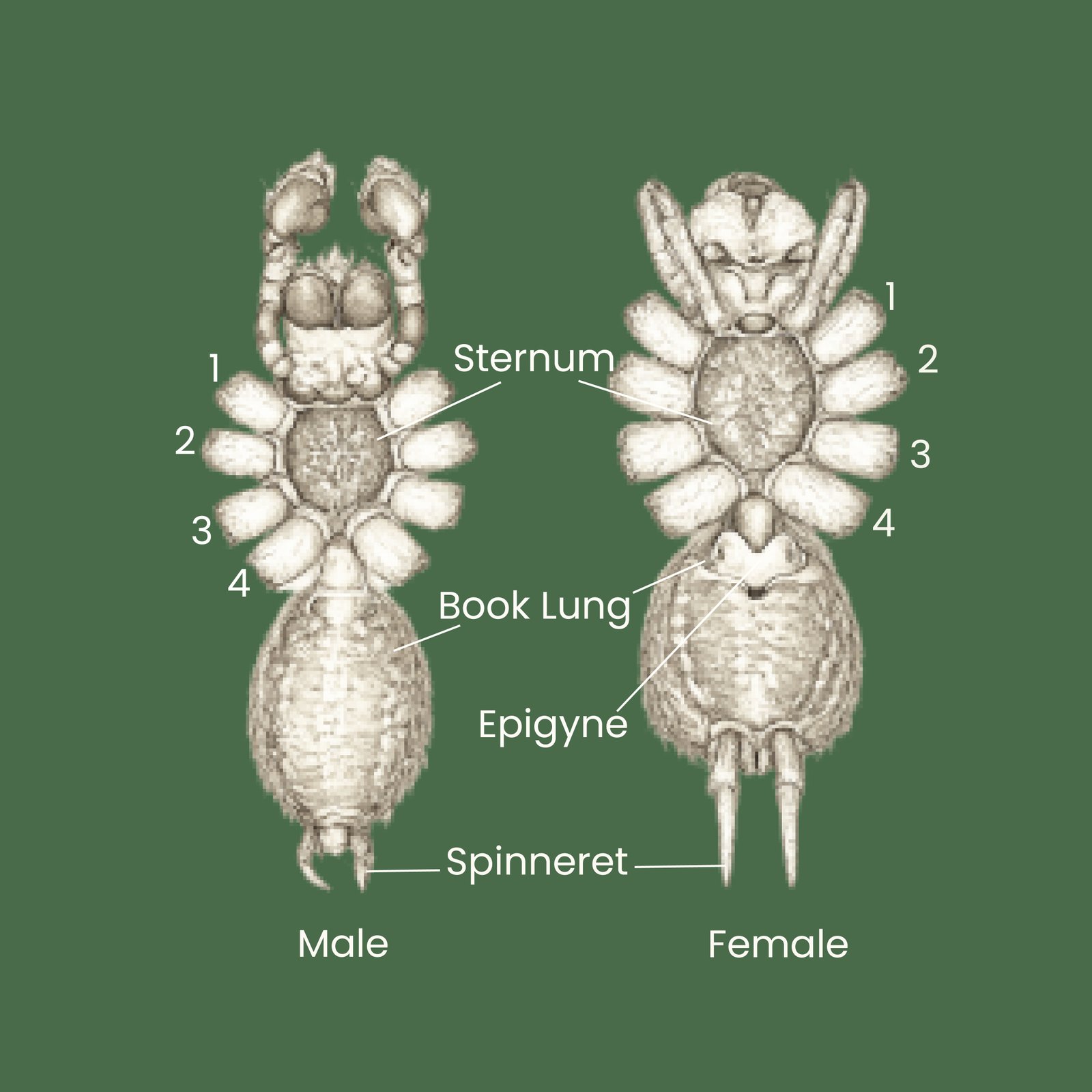
Sexual Dimorphism & Ventral Structures
The ventral surface reveals the structures responsible for respiration and reproduction, showcasing clear differences between males and females.
Sternum
A flat, shield-shaped plate on the ventral side of the prosoma, situated between the leg bases, providing structural support to the cephalothorax.
Book Lungs
Pairs of respiratory organs visible as faint, pale patches on the anterior ventral side of the opisthosoma. They consist of leaf-like vascularized plates stacked together like pages in a book, facilitating efficient gas exchange.
Epigyne (Female Only)
A specialized, hardened (sclerotized) external plate located on the ventral midline of the female abdomen. It contains openings leading to the internal spermathecae where the male's sperm is stored after mating.
Male Pedipalps
In males, the distal ends of the pedipalps are highly modified, swollen structures (often resembling boxing gloves) that function as complex secondary sex organs used to transfer sperm to the female epigyne.
Spinnerets
Located at the posterior terminus, these structures are present in both sexes but vary in use depending on reproductive and lifestyle behaviors.
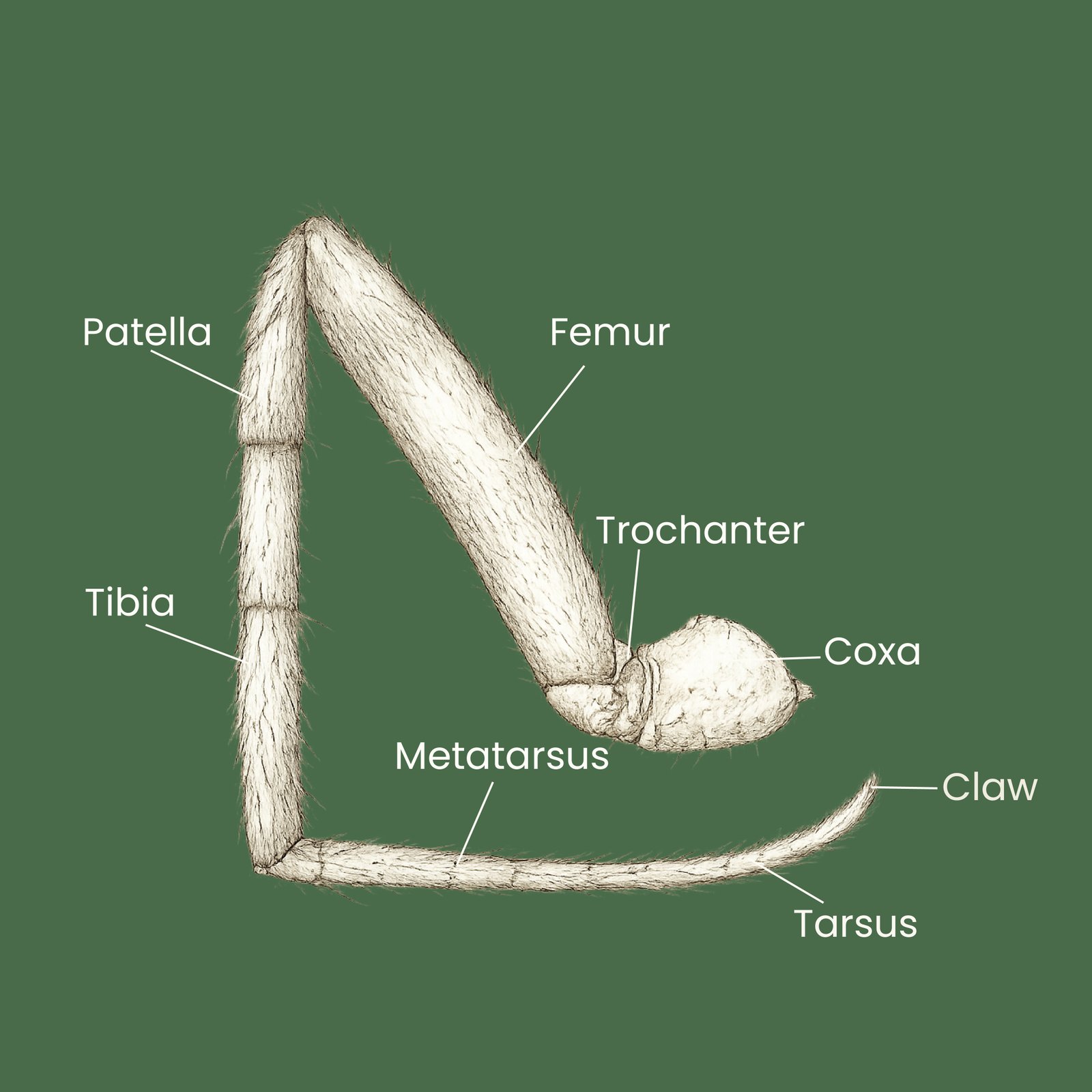
Leg Segmentation in Detail
Each of the spider's eight walking legs is highly articulated, consisting of seven distinct segments configured to optimize leverage, speed, and sensory input.
Coxa
The short, robust proximal segment that anchors the leg firmly to the lateral margins of the prosoma.
Trochanter
A small, pivoting segment acting as a hinge between the coxa and the femur, allowing smooth multi-directional adjustments.
Femur
The longest and thickest segment of the leg, packed with powerful muscles that drive locomotion and jumping capabilities.
Patella
A short, rigid knee-like joint that connects the femur to the tibia, providing a structural pivot point for vertical leg movement.
Tibia
A long, strong segment typically equipped with protective spines and tactile hairs to detect vibrations and air currents.
Metatarsus
A slender, flexible segment located between the tibia and tarsus, adding extra reach and springiness to the gait.
Tarsus
The ultimate, distal segment of the leg, acting as the spider's "foot". It is densely covered in specialized sensory hairs.
Claw
Situated at the tip of the tarsus. Hunting spiders like wolf spiders typically possess two or three tiny, curved claws that provide an exceptional grip on rough surfaces, silk webs, or prey.